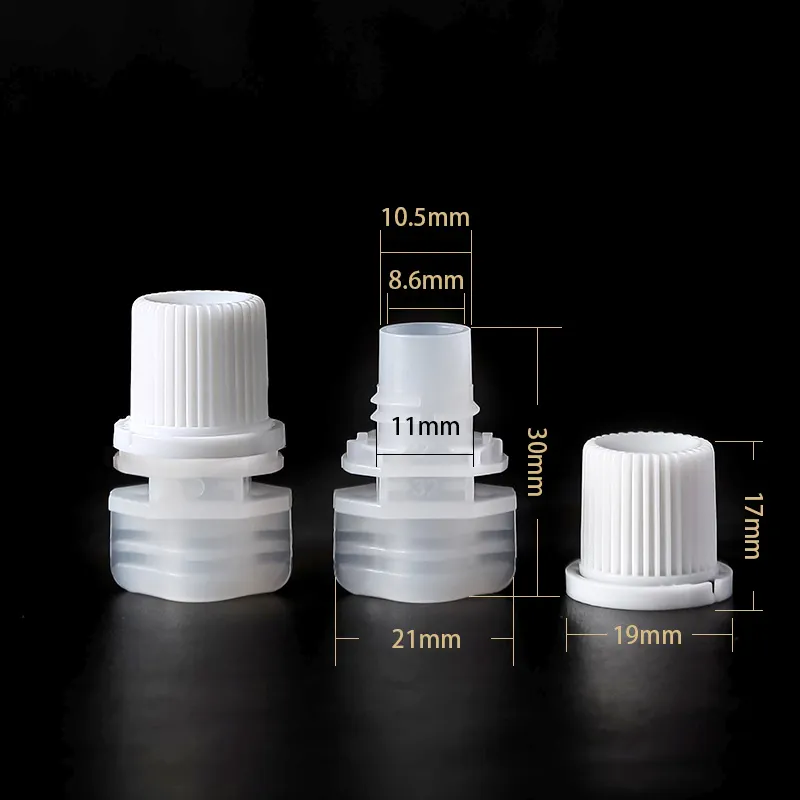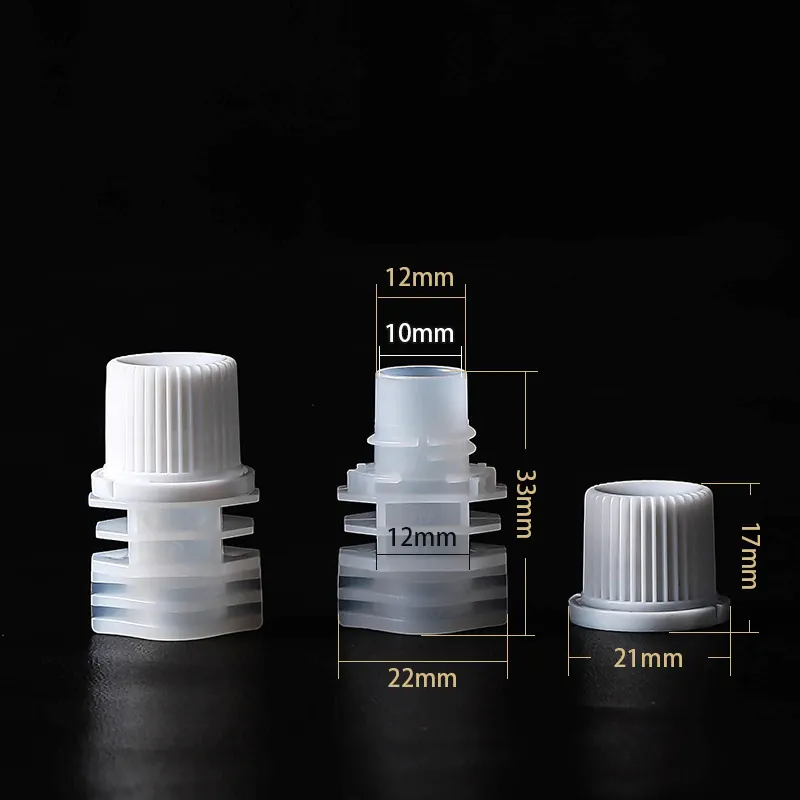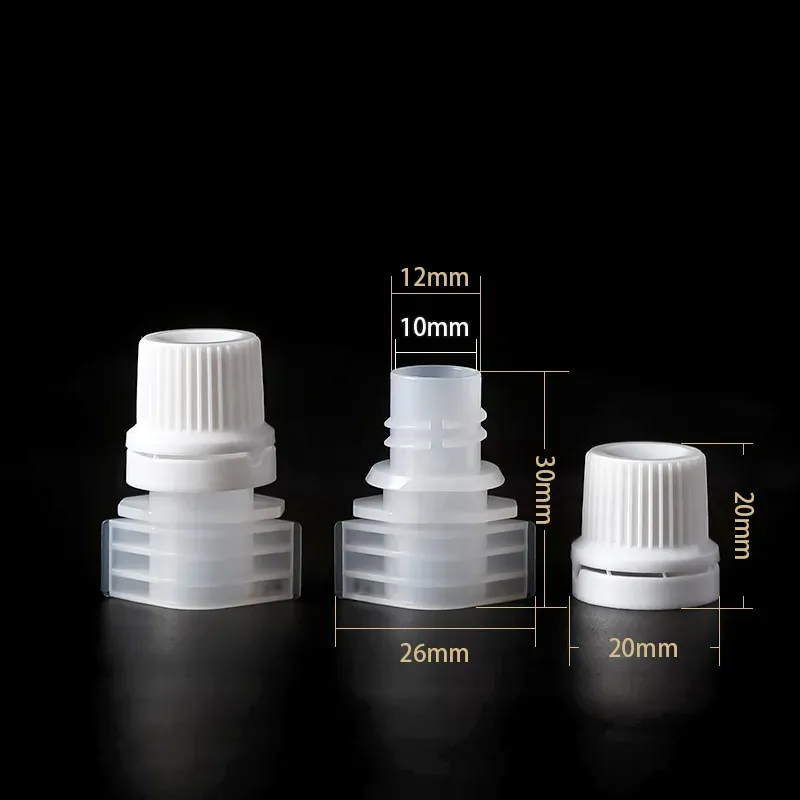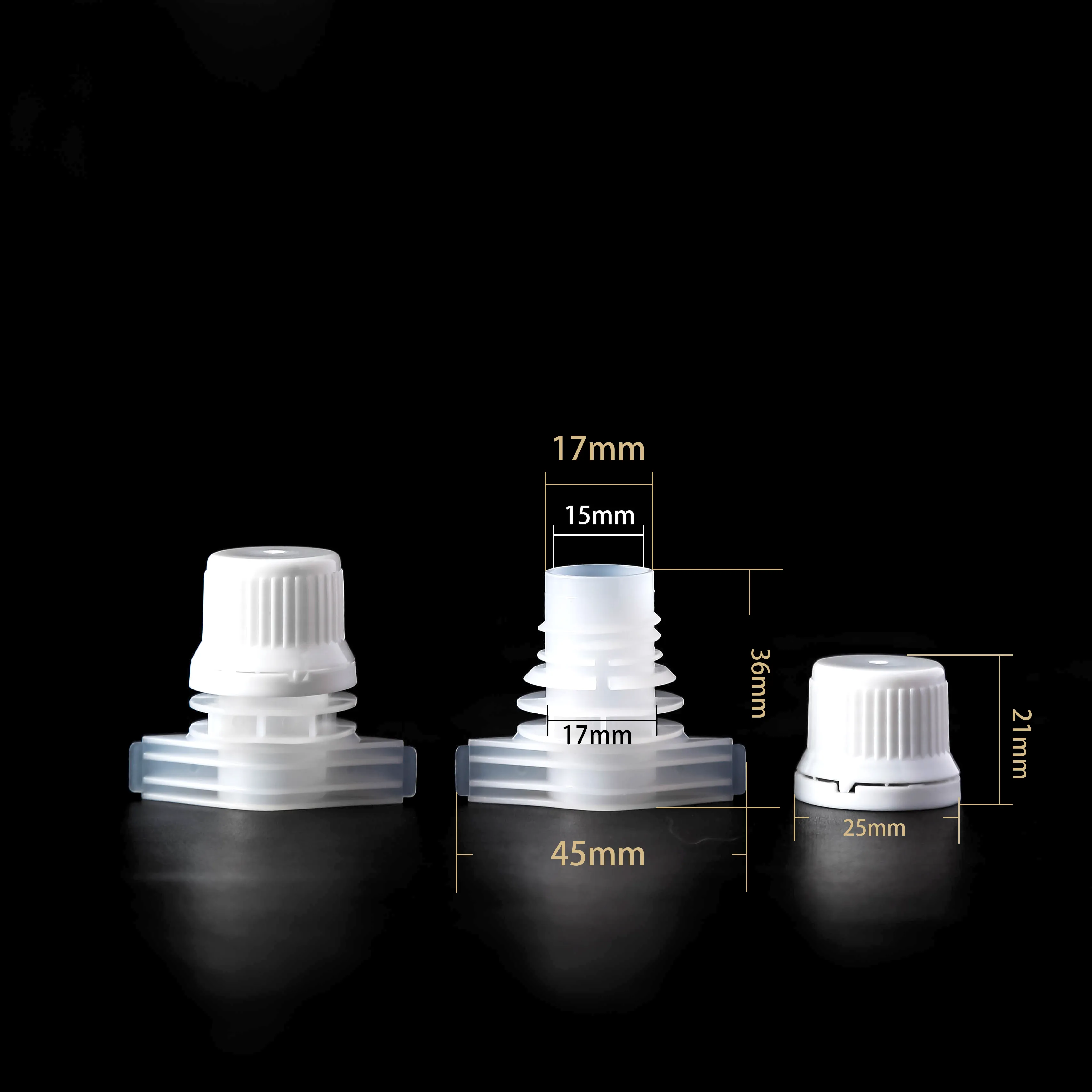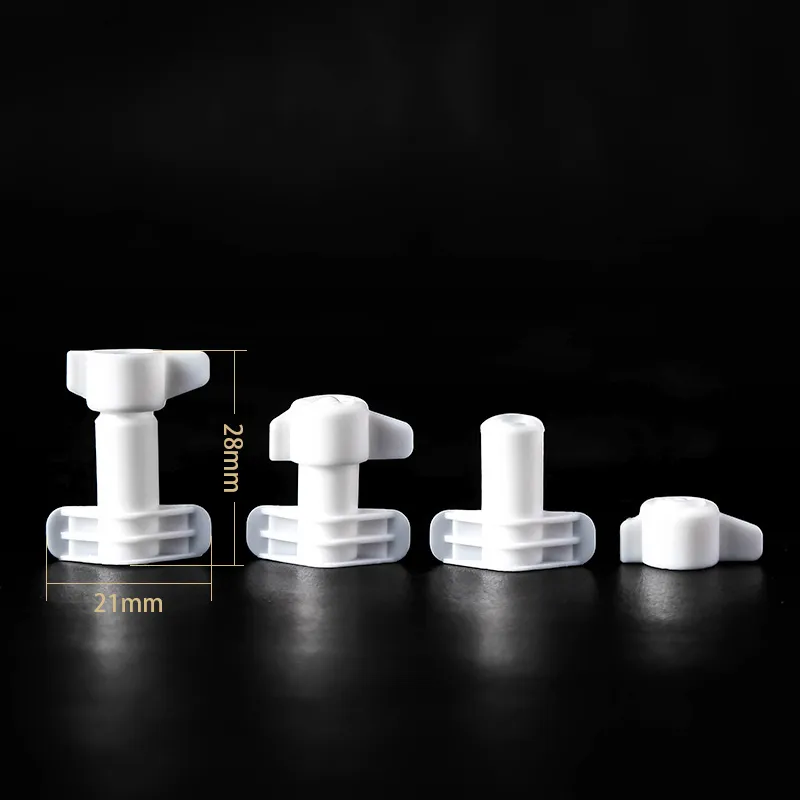







A spout cap is the injection-molded component that controls dispensing, resealing, and user interaction on spouted pouches and refill packs.
As a professional spout cap manufacturer, I will introduce you to the commonly used materials in the manufacture of spout caps.
Polypropylene (PP): The Most Widely Used Spout Cap Material
Key properties
- High rigidity and dimensional stability for accurate thread geometry.
- Excellent fatigue resistance for repeated open/close cycles.
- Good chemical resistance to many oils, acids, and common solvents.
- Higher heat tolerance among commodity resins—suitable for moderate hot-fill.
Typical applications
- Beverage pouches (cold and many hot-fill lines).
- Baby food and puree pouches.
- Sauce and condiment packaging.
- Personal care liquids (shampoos, body wash).

When to choose PP
Use PP when you need structural integrity (sharp threads and tamper features), moderate hot-fill resistance, and broad chemical compatibility. PP is the default for spout cap parts where a balance of stiffness, cost, and heat resistance matters.
High-Density Polyethylene (HDPE): Tough and Chemically Stable
Key properties
- High impact resistance and toughness.
- Strong resistance to alkaline and many detergent chemistries.
- Good dimensional stability under stress and drop-impact.
Typical applications
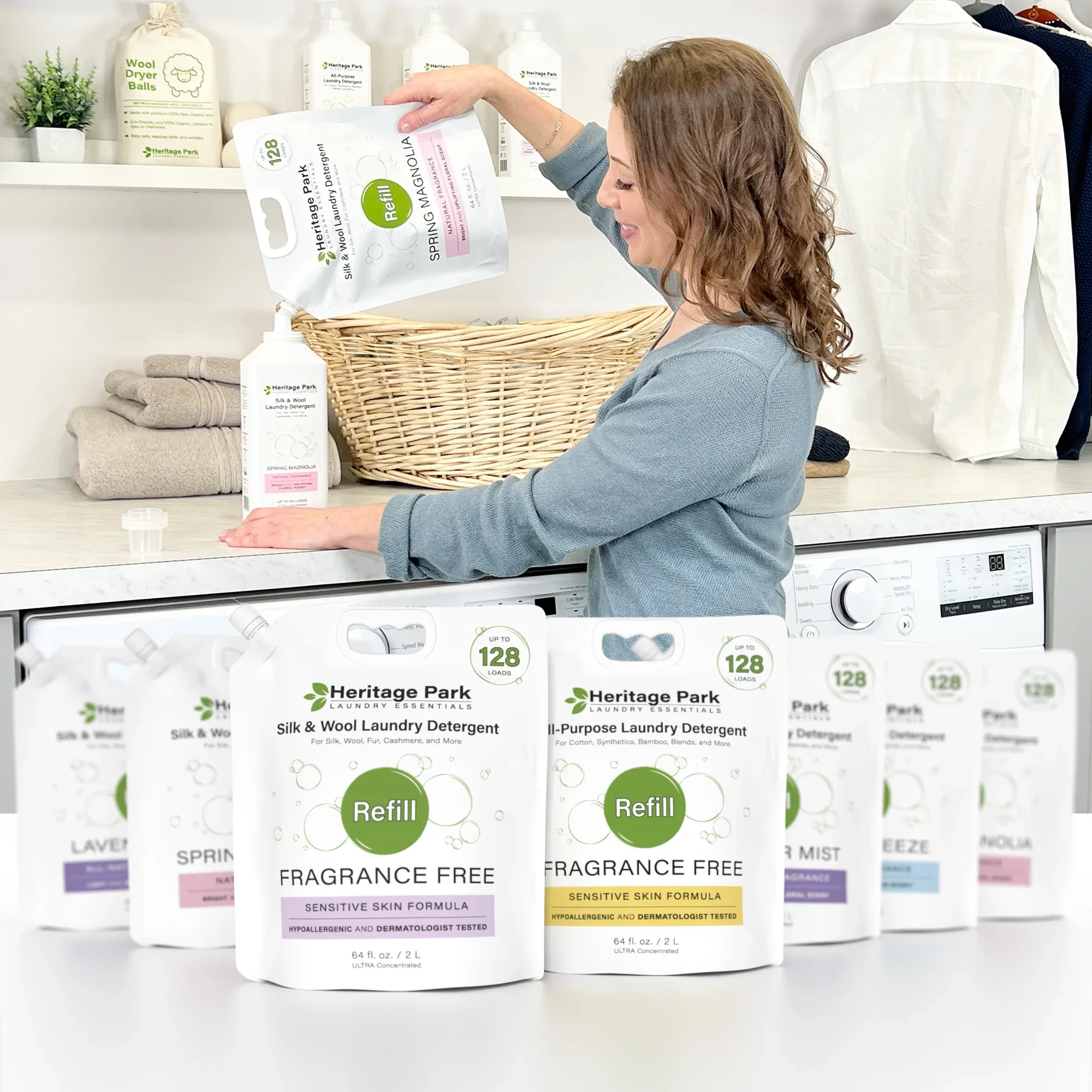
- Household cleaners and laundry detergent refill pouches.
- Industrial liquids and chemical concentrates.
- Any application requiring rugged handling.
When to choose HDPE
In a harsh industrial environment, choose HDPE for toxic/alkaline chemistries, applications that require better drop resistance than PP, or when the spout cap will be used in heavy-duty logistics environments. HDPE trades some heat tolerance for toughness.
Low-Density Polyethylene (LDPE): Flexible and Soft
Key properties
- High flexibility and elongation; softer than PP/HDPE.
- Good sealing behavior against rigid seat geometries.
- Lower melting point—easier to weld into heat-seal assemblies in some processes.
Typical applications
- Internal sealing inserts, soft over-molding, or liner components.
- Low-torque opening caps and soft-touch dispensing features.
- Parts that require compression-based seals rather than purely thread seals.

When to choose LDPE
Use LDPE for components where compliance and sealability are prioritized—e.g., soft inner plugs, low-torque manual-open caps, or where the spout cap contains a flexible gasket function. LDPE is not ideal when high structural stiffness is required.
Specialized Materials for Spout Cap Components
Silicone sealing components
Characteristics: Outstanding elasticity, temperature tolerance, and long-term seal integrity.
Use cases: High-performance seals in demanding food or industrial applications; parts where thermal cycling is common.
When to use: When you must guarantee leak-free performance across wide temperature ranges or where polymer migration must be minimized.
Thermoplastic Elastomer (TPE)
Characteristics: Rubber-like resilience combined with thermoplastic processing; good compression set resistance.
Use cases: Over-molded soft-touch collars, integrated gaskets, controlled-flow tappets.
When to use: For premium user experience (soft-feel caps), enhanced sealing without separate gaskets, or when injection-molding simplicity is required over silicone insert molding.
Material Comparison Table for Spout Cap Manufacturing
| Beverage pouches, baby food, and sauces | Key Strengths | Limitations | Typical Applications |
|---|---|---|---|
| PP | Rigidity, heat resistance, chemical stability | Less flexible at low temp | Beverage pouches, baby food, sauces |
| HDPE | Toughness, impact & chemical resistance | Lower heat resistance vs PP | Detergents, industrial fluids |
| LDPE | Flexibility, sealability | Lower structural strength | Soft seals, liners |
| TPE | Elastomeric sealing, soft-touch | Higher cost | Premium dispensing caps |
| Silicone | Wide temp range, durable seals | Processing complexity, cost | Beverage pouches, baby food, and sauces |
Practical Spout Cap Materials Selection Guidance
- If you need crisp threads, tamper features, and hot-fill tolerance → choose PP.
- If the product is chemically aggressive or the cap must withstand abuse → choose HDPE.
- If sealing and compliance (soft contact) are primary → use LDPE or a soft insert.
- If the user experiences or integrated soft sealing is a selling point → use TPE overmolding.
- If thermal cycling or extreme temperature range is in the spec → consider silicone sealing inserts.
Emerging Trends of Spout Cap Materials
- Mono-material recyclable systems: demand for chemically compatible polymers that allow the entire pouch + spout cap system to be recycled together is rising. That pushes designers to rethink blends and choose polymers compatible with the target recycling stream.
- Lightweight optimization: wall thinning and structural redesign enable manufacturers to reduce resin use while maintaining performance—material selection must account for thinner-section behavior.
- Food-safety and regulatory pressure: increased scrutiny on extractables/migrants drives selection of higher-purity food-grade grades and documented supply chains.
Conclusion
Selecting the right material for a spout cap is an engineering decision, not a commodity purchase. PP and HDPE remain the backbone of most applications because they balance cost, durability, and chemical resistance. LDPE, TPE, and silicone are the targeted choices when flexibility, user experience, or extreme sealing performance are required. Final selection should be validated by prototype torque/leak tests, chemical compatibility trials, and packaging-weld trials under the expected logistics conditions. If you provide product chemistry, fill temperature, and expected distribution profile, a precise material and construction recommendation can be produced.
About Sanrun

Sanrun is a top spout cap manufacturer in China, providing injection-molded dispensing solutions for global B2B packaging markets. With advanced molding technology and strict process control, Sanrun ensures consistent batch quality and reliable sealing performance across high-volume production.
Sanrun focuses on material-driven engineering, offering spout caps in PP, PE, and elastomer combinations tailored to different product chemistries and filling conditions. For brand owners and packaging converters, we deliver flexible OEM spout cap and ODM spout cap services, including custom cap design, material selection, and structural optimization to support stable production and efficient supply chains.